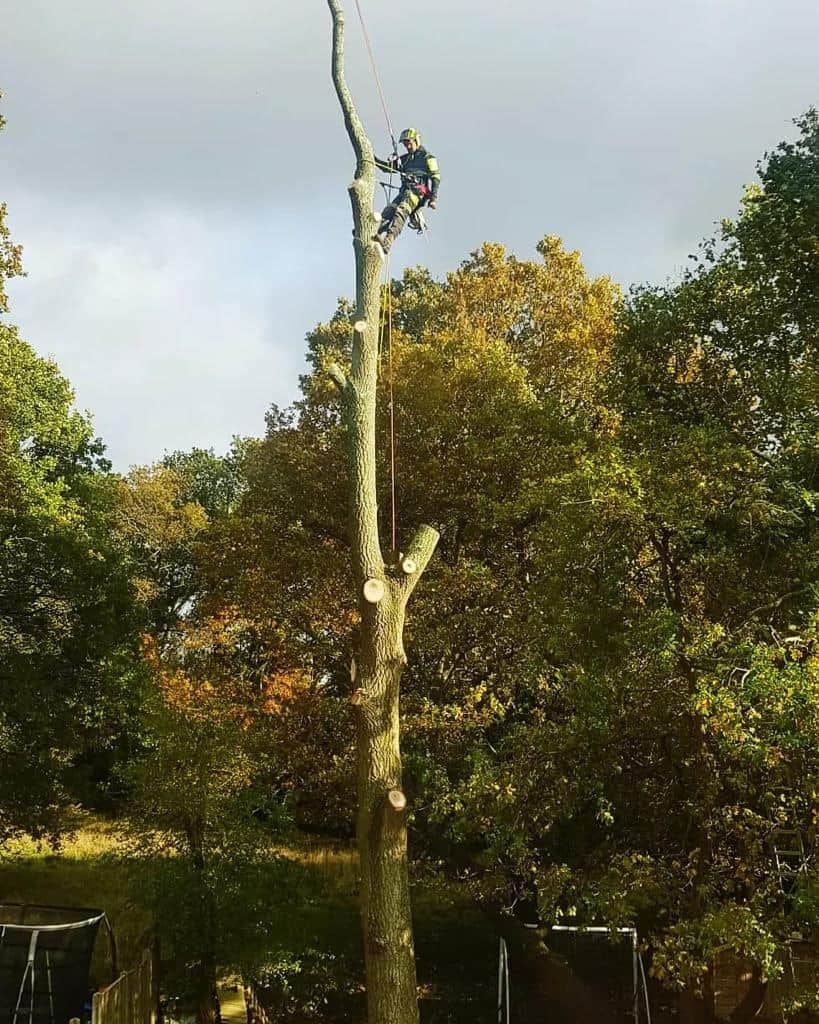
Once a tree has been felled, the remaining stump can look like a relatively straightforward final obstacle. Above ground, there may only be a short section of timber left behind, leading homeowners to assume that digging around it and cutting a few roots will be enough to remove it.
In reality, a large tree stump can be one of the most difficult parts of a tree to remove manually. The visible timber represents only part of the problem. Beneath the soil can be a substantial network of strong roots that has developed over many years, firmly anchoring the stump into the surrounding ground.
For homeowners in Southsea, Hampshire, professional stump grinding can provide a much more practical way of dealing with unwanted stumps. LM Tree Surgery Southsea can assess the stump, its location and the surrounding garden before determining an appropriate approach.
Why Does a Tree Stump Remain So Secure After the Tree Is Felled?
Trees need strong anchorage to remain stable while exposed to wind and changing weather. During their lifetime, they develop substantial root systems that spread through the surrounding ground.
Felling the tree removes the trunk and crown, but it does not automatically remove this underground structure.
The stump remains connected to major roots, which is why even a relatively short section of remaining trunk can be extremely difficult to move.
Manual Removal Can Involve Dealing With:
- Dense stump timber
- Large structural roots
- Smaller surrounding roots
- Compacted soil
- Restricted working space
- Roots extending in several directions
- Hidden obstacles within the ground
The larger and more established the original tree, the more demanding manual stump removal can become.
1. Large Stumps Can Contain a Substantial Amount of Timber
A mature tree trunk can be extremely substantial at ground level.
Even after the tree has been cut down, the remaining stump may contain a considerable volume of dense timber. Attempting to break this material apart manually can require significant effort.
The stump is also usually strongest around its base, where the trunk transitions into the major roots.
This means homeowners are not simply trying to remove a piece of wood sitting in the ground. They are dealing with an integrated structure that has grown into and through the surrounding soil.
2. Major Roots Can Extend Well Beyond the Visible Stump
One of the biggest challenges is that the size of the underground root system is not immediately obvious.
Roots can extend outwards from the stump in multiple directions. Some may remain close to the surface, while others can be positioned deeper within the ground.
When attempting manual removal, these roots may need to be exposed before they can even be identified.
The Process Can Quickly Become Much Larger Than Expected
A homeowner may begin by excavating immediately around the stump but then discover substantial roots continuing beyond the original hole.
More soil has to be removed to gain access, creating an increasingly large excavation area.
This is one reason a seemingly straightforward garden task can develop into a significant amount of work.
3. Roots Are Designed to Resist Movement
The root system has spent years supporting the tree.
Its purpose includes providing anchorage, so it is unsurprising that the remaining stump does not simply lift from the ground once the trunk has been removed.
Several substantial roots may need to be disconnected before meaningful movement is possible.
Even after visible roots have been cut, smaller or deeper connections can continue holding the stump securely in position.
4. Access Around the Stump Can Be Restricted
Tree stumps are not always conveniently positioned in the middle of an open lawn.
They may be situated close to existing garden features, making excavation considerably more awkward.
Stumps May Be Located Near:
- Fences
- Garden paths
- Driveways
- Patios
- Walls
- Planting areas
- Sheds or garden buildings
- Other established trees and shrubs
In these situations, digging a large area around the stump may be undesirable or impractical.
Professional stump grinding can often provide a more targeted approach because the work concentrates primarily on reducing the stump itself.
5. Soil Can Be Difficult to Remove From Around Established Roots
The ground immediately around a mature stump is rarely empty, loose soil.
Roots occupy the area and can make digging awkward. Soil may also be compacted, while stones and other underground materials can make progress slower.
Every major root needs sufficient access before it can be dealt with manually.
As the excavation expands, the volume of soil that needs to be moved also increases.
For a large stump, this can turn removal into a considerable physical task before the stump itself has even been loosened.
6. The Weight of the Stump Can Be Easily Underestimated
Even after enough roots have been disconnected, there is another issue: the weight of the remaining stump.
Large sections of solid timber can be extremely heavy.
The root base may also retain soil between and around its roots, adding further bulk.
Successfully loosening a stump therefore does not necessarily mean it can simply be lifted out of the excavation. Moving and handling the remaining material can be another significant part of the process.
7. Manual Removal Can Disturb a Large Area of the Garden
Removing an entire stump and major root base manually generally requires excavation around the structure.
For a small stump in an open area, this may be manageable. For a large established stump, the amount of ground disturbance can be substantially greater.
A wide hole may be required simply to expose enough of the root system to release it.
Where homeowners want to retain the surrounding lawn, planting or landscaping, extensive excavation may be undesirable.
Why Does Stump Size Make Such a Difference?
The diameter of the stump provides some indication of the scale of the task, although the underground structure also matters.
A larger tree will generally have required substantial anchorage during its lifetime.
Its stump may therefore be connected to thick structural roots that are considerably more challenging to expose and disconnect manually than those associated with a small tree.
Other Factors Affecting Difficulty Include:
- Tree species
- Age of the stump
- Root structure
- Ground conditions
- Stump position
- Available access
- Surrounding landscaping
- Intended use of the area afterwards
This is why two stumps that look relatively similar above ground can require different approaches.
Does Leaving the Stump to Decay Make Removal Easier?
Dead timber will eventually deteriorate naturally, but this can be a slow process.
Leaving a stump to decay may be acceptable where it occupies an unused part of the garden and causes no inconvenience. However, it is less practical when the stump is positioned in an area that the homeowner wants to use.
During this period, the stump remains an obstacle.
It can continue interfering with mowing, landscaping and the general layout of the garden while the timber gradually breaks down.
What Is Stump Grinding?
Stump grinding uses specialist machinery to progressively reduce the remaining stump.
Rather than excavating the complete stump and major root structure in one piece, the grinding equipment removes the timber in controlled stages.
The main stump can be reduced below the surrounding ground level, removing the prominent obstruction.
This Approach Can Be Particularly Useful Because It:
- Avoids manually excavating the entire root base
- Concentrates work around the stump
- Reduces substantial timber efficiently
- Can limit unnecessary disturbance to surrounding ground
- Leaves the area easier to incorporate into the garden
The precise approach depends on the stump and what the homeowner intends to do with the area afterwards.
Does Stump Grinding Remove the Entire Root System?
Stump grinding is different from completely excavating every root.
The primary objective is usually to remove the main stump and accessible root material around it to an appropriate depth. Roots extending further through the surrounding ground are generally left in place to deteriorate naturally.
This is one reason grinding can be less disruptive than attempting to excavate an entire mature root network.
The required grinding depth should be considered according to the future plans for the area.
Why Is Professional Equipment So Valuable?
Large tree stumps are extremely resistant to ordinary manual methods because they combine dense timber with strong underground anchorage.
Specialist stump grinding machinery is designed specifically to reduce this material.
However, operating around a stump requires more than simply positioning machinery and beginning work.
The surrounding area needs to be considered carefully, including access, nearby garden features and the amount of stump that needs removing.
Professional assessment allows the work to be planned according to the actual site rather than treating every stump identically.
When Is Professional Stump Grinding Particularly Worth Considering?
Professional stump grinding can be especially useful when:
- The stump is large
- Manual excavation would disturb substantial ground
- Several stumps require removal
- The stump is interfering with garden use
- Landscaping work is planned
- The stump prevents easy lawn maintenance
- Access around the stump is restricted
- The remaining timber is particularly substantial
It can also provide a more complete finish following tree felling where there is no reason to retain the stump.
What Happens to the Ground Afterwards?
Once the main stump has been ground down, the affected area can be considered according to its intended future use.
This is important because different plans may require different preparation.
A homeowner wanting to incorporate the area into a garden border may have different requirements from someone wanting to improve the surrounding lawn.
Thinking about the next use of the space before stump grinding begins can help determine the most appropriate extent of the work.
Can Stump Grinding Make a Garden More Usable?
Yes. Removing an unwanted stump can make a surprisingly noticeable difference, particularly in smaller gardens.
A stump can prevent furniture from being positioned where desired, interrupt lawn maintenance or restrict a future garden layout.
Once the main obstruction has been removed, homeowners have greater flexibility over how the area is used.
Stump Removal Can Help Prepare Space For:
- Lawn improvement
- New planting
- Garden redesign
- Improved access
- General landscaping
- A more open garden layout
It can also leave the original tree removal looking more complete.
Why DIY Stump Removal Can Become a Much Bigger Job Than Expected
The main difficulty with manual stump removal is that much of the task remains hidden until excavation begins.
What appears to be a manageable stump at surface level may be connected to thick roots extending in several directions.
Homeowners can therefore spend considerable effort digging before discovering that the stump is still firmly anchored.
Professional stump grinding approaches the problem differently. Instead of attempting to remove the complete underground structure intact, specialist machinery progressively reduces the main obstruction.
For substantial stumps, this can be a much more practical method.
Professional Stump Grinding in Southsea
For homeowners in Southsea, Hampshire, LM Tree Surgery Southsea provides professional tree surgery and stump grinding for unwanted tree stumps.
Whether a stump has recently been left following tree felling or has occupied part of the garden for some time, its size, position and surrounding area should be assessed before deciding how best to deal with it.
Professional stump grinding can reduce the main obstruction while avoiding the extensive manual excavation that complete stump removal may otherwise require.
Conclusion
Large tree stumps are difficult to remove manually because the visible timber is only part of the structure. Beneath the surface, substantial roots can extend through the surrounding soil and continue anchoring the stump firmly into the ground.
Manual removal may involve extensive digging, exposing and cutting roots, dealing with dense timber and eventually moving a heavy stump and root base. For established trees, the amount of work can quickly become much greater than expected.
Stump grinding provides a more targeted approach by mechanically reducing the main stump rather than requiring the entire root structure to be excavated intact.
If you have an unwanted tree stump in Southsea, Hampshire, LM Tree Surgery Southsea can assess its size and location and provide professional stump grinding to help leave your garden clearer, tidier and easier to use.
Call us on: 023 8235 3277
Click here to find out more about LM Tree Surgery Southsea
Click here to complete our contact form and see how we can help with your tree needs.