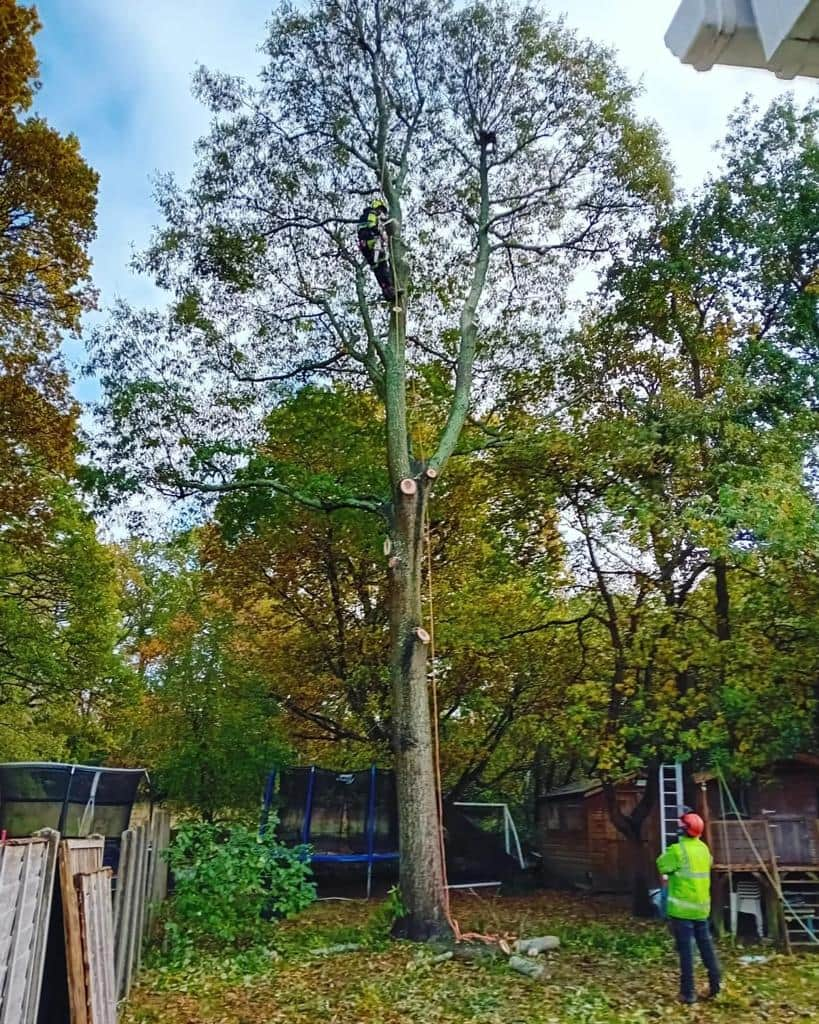
A tree does not necessarily require attention simply because it has grown large. Mature trees can provide valuable shade, character and screening when their crowns remain healthy, balanced and suitable for their surroundings. However, excessive or poorly directed growth can create practical problems and place unnecessary strain on individual branches.
For property owners in Southsea, Hampshire, arranging a professional tree assessment at the right time can help identify whether pruning, crown reduction, reshaping or another form of tree surgery is appropriate.
Signs an Overgrown Tree May Need Professional Attention
The decision should be based on the tree’s condition, structure and relationship with the surrounding property. Cutting branches without understanding their role within the crown can produce weak regrowth, spoil the tree’s shape and create further management problems.
Branches Are Growing Too Close to the Property
Branches extending towards roofs, windows, gutters or exterior walls should be assessed before they make repeated contact. Movement during windy conditions can cause branches to rub against roofing materials or strike parts of the building.
Selective pruning may provide suitable clearance while retaining the tree’s natural shape. The objective is not simply to shorten every nearby branch, but to identify suitable growth points and create enough separation for future development.
The Crown Has Become Unbalanced
An overgrown tree may develop more weight on one side because of available light, previous pruning or competition from surrounding vegetation. Long, heavily extended limbs can create an uneven crown and place greater leverage on branch unions.
Professional reshaping or crown reduction can redistribute the canopy more evenly. Each cut should be selected carefully so that the remaining branches form a balanced structure rather than an artificial outline.
Lower Branches Are Restricting Access
Low or drooping branches can obstruct driveways, paths, seating areas and entrances. They may also interfere with routine garden maintenance or make parts of the property difficult to use.
Crown lifting can increase clearance by removing or shortening selected lower branches. The amount removed must remain proportionate to the tree, as excessive lifting can leave the crown top-heavy and reduce the visual balance of the trunk.
Dense Growth Is Reducing Light and Airflow
A crowded canopy can cast substantial shade and restrict air movement through the tree. Crossing branches may rub together, while congested shoots compete for space.
Selective thinning or pruning can remove specific secondary branches without dramatically altering the tree’s overall size. This allows more light to pass through the crown while retaining its main framework.
Thinning should be distributed evenly. Removing too much internal growth can leave the outer canopy exposed and encourage an undesirable concentration of foliage at the branch ends.
Branches Have Become Long and Heavily Weighted
Mature limbs may extend beyond the main crown and carry considerable weight at their tips. These overextended branches can move more dramatically during strong winds and may place stress on their attachment points.
Targeted reduction can shorten selected limbs back to suitable lateral branches. This decreases end weight while maintaining a natural continuation of the branch structure.
Simply cutting the branch at an arbitrary point can leave a stub and encourage clusters of weak shoots.
Dead or Damaged Wood Is Present
Dead branches do not always fall immediately. They may remain within the crown while becoming increasingly brittle. Cracks, splits and hanging branches also warrant professional attention, especially above frequently used parts of the garden.
Deadwood removal targets affected branches while preserving healthy growth. During the work, the wider crown can also be inspected for additional defects that may not be visible from the ground.
The Tree Has Outgrown Its Available Space
Some trees eventually become too large for the position in which they are growing. Their crowns may dominate a small garden, extend across several access routes or repeatedly require clearance from nearby structures.
Crown reduction may make the tree more suitable for its setting by decreasing its height, spread or overall volume. The achievable reduction depends on the species, age, condition and previous management of the tree.
A staged approach may be preferable when a substantial change is needed, particularly for mature specimens.
Previous Cutting Has Created Dense Regrowth
Poorly positioned or severe cuts can stimulate clusters of vigorous shoots. These may grow rapidly, produce an uneven crown and require further management sooner than expected.
Professional tree surgery can assess which shoots should be retained and which can be removed or shortened. Corrective work may need to take place gradually so that the tree is not subjected to another excessive loss of foliage.
The Tree’s Shape Has Become Uneven
Uneven growth may develop after branch loss, storm damage, competition for light or earlier pruning. One section may appear sparse while another becomes dense and extended.
Tree reshaping uses selective cuts to improve proportion without forcing the crown into an unsuitable form. The tree’s natural growth habit should guide the work, as different species develop different shapes and branch arrangements.
Growth Is Affecting Several Parts of the Garden
An overgrown crown can affect more than one feature at the same time. It may shade planting, narrow a path, obstruct a view and extend above a roof or parking area.
In this situation, addressing one branch at a time without an overall plan can leave the canopy unbalanced. A complete assessment allows the required clearances and the tree’s structural needs to be considered together.
Why Professional Assessment Matters
Before recommending work, a tree surgeon should examine:
- The species, age and condition of the tree
- Its natural crown shape
- Branch unions and structural balance
- Dead, damaged or crossing branches
- Clearance from buildings and access routes
- The amount of foliage that can be removed
- How the tree is likely to respond to pruning
- The most appropriate type of tree surgery
This prevents unnecessary cutting and helps ensure that the selected work addresses the actual problem.
When to Act Promptly
An assessment should be arranged promptly if branches are cracked, hanging, recently damaged or moving unusually. Sudden changes in the tree’s lean, crown shape or branch structure should also be examined rather than waiting for routine maintenance.
Where the problem is simply gradual overgrowth, planned work can be scheduled according to the species and the type of pruning required.
Conclusion
Tree surgery should be considered when an overgrown tree begins affecting buildings, access, light, structural balance or the practical use of the garden. The correct solution may involve pruning, crown lifting, thinning, reduction, reshaping or deadwood removal, depending on the individual tree.
LM Tree Surgery Southsea provides professional tree assessments and tree surgery in Southsea, Hampshire. If a tree has become difficult to manage or appears unbalanced, contact our team to determine the most appropriate form of care.
Call us on: 023 8235 3277
Click here to find out more about LM Tree Surgery Southsea
Click here to complete our contact form and see how we can help with your tree needs.